CNIPA Publishes 15th Five-Year Plan for Patent and Trademark Examination

Share Post:

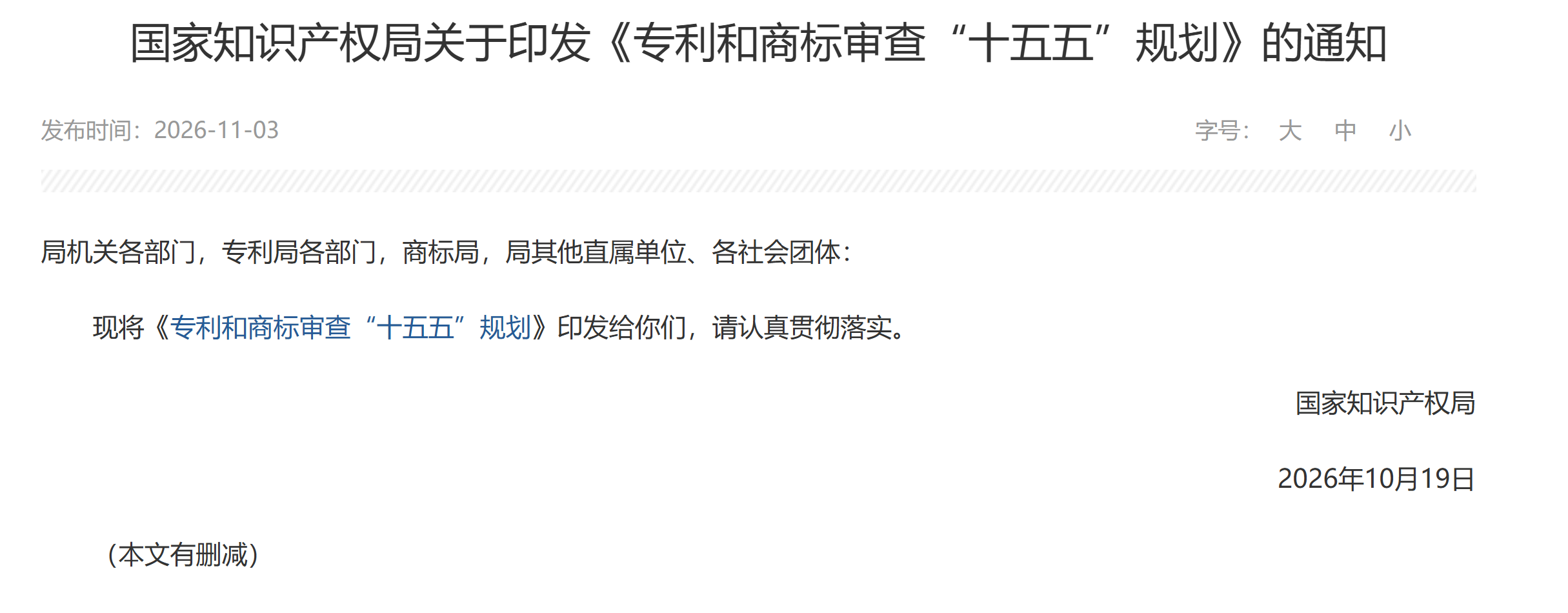
China’s National Intellectual Property Administration (CNIPA) published the “Patent and Trademark Examination 15th Five-Year Plan” (专利和商标审查“十五五”规划) on November 3, 2026. The plan sets out goals, tasks, and specific projects for patent and trademark examination work covering the 2026-2030 period, and it was issued pursuant to two earlier policy documents: the Outline for Building a Powerful Intellectual Property Nation (2021-2035) and the IP Protection and Utilization 15th Five-Year Plan.
 

The plan states five guiding principles for examination work during this period: prioritizing quality, pursuing reform and innovation in examination rules and management, aligning examination policy with industrial development, coordinating patent and trademark examination systems, and applying artificial intelligence across examination processes. It sets a target that by 2030, CNIPA will have established an examination institution it describes as world-class, with improved examination quality, stronger support for development, deeper international cooperation, and leading examination capacity globally.

On patents, the plan calls for research into revisions to the Patent Law, its implementing regulations, and the Patent Examination Guidelines, including study of priority rights, grace periods for novelty, and deferred examination procedures, with reference to aligning with international agreements such as the Comprehensive and Progressive Agreement for Trans-Pacific Partnership (CPTPP), a multilateral free trade agreement among eleven Pacific Rim economies that includes an intellectual property chapter. It calls for updated examination standards in emerging technology areas including artificial intelligence, big data, and gene technology, as well as standards for biobreeding, green and low-carbon technology, and traditional Chinese medicine. A dedicated section on emerging-field examination rules raises several specific AI-related questions for study: how to define the person skilled in the art and the scope of prior art for AI-assisted inventions, how to treat inventorship and patentability for AI-generated inventions, and whether to require disclosure of AI use in patent applications. The plan also references work on standard-essential patent examination and on protection of graphical user interfaces and other digital subject matter in design patents.

Under the section on examination management, the plan states that CNIPA will strengthen guidance from post-grant procedures such as reexamination back to initial examination, and will research providing pre-search reports for invention patent applications as a way to optimize the examination procedure. No further detail, timeline, or scope is given for this item in the text. The plan also calls for building what it terms “AI+” examination management mechanisms and for closer coordination between examination and industrial policy, including a mechanism for joint examination of major patent cases.

The plan addresses patent application quality, calling for enforcement of good-faith filing principles, continued identification and handling of applications found to violate that principle, and research into a pre-filing evaluation system centered on the commercialization prospects of an application. It also addresses quality management for reexamination and invalidation proceedings, utility model examination, and design patent examination under the Hague system, and calls for maintaining patent examination pendency at a level the plan describes as leading among major patent offices operating under comparable examination systems.

On trademarks, the plan calls for implementation of the revised Trademark Law and continued work on revising its implementing regulations. It calls for study of standards for new trademark types, reform of the internal examination sign-off process to improve consistency, expansion of fast-track and applicant-requested deferred examination options, and a pilot “AI plus big data” examination model. Several sections address bad-faith trademark registration, including monitoring of trademark agencies that represent applicants engaged in bad-faith filing, use of business registration data to identify such filings, and coordination between invalidation procedures and administrative enforcement. The plan also addresses examination standards for collective and certification trademarks based on geographical indications, including verification of historical records and standardization of geographical indication names and protected areas.

On international cooperation, the plan references continued participation in processes under the World Intellectual Property Organization (WIPO), a United Nations agency based in Geneva that administers international IP treaties and systems including the Patent Cooperation Treaty and the Madrid System for trademarks. The plan also references the IP5, a cooperation framework among the five largest patent offices by filing volume, namely CNIPA, the United States Patent and Trademark Office (USPTO), the European Patent Office (EPO), the Japan Patent Office (JPO), and the Korean Intellectual Property Office (KIPO), as well as cooperation under BRICS, an intergovernmental grouping originally comprising Brazil, Russia, India, China, and South Africa that has since expanded to include additional member states. The plan also references exchanges with Belt and Road partner countries, continued expansion of the Patent Prosecution Highway network, and support for Chinese applicants pursuing overseas patent and trademark protection.

The final sections of the plan address workforce development, including tiered training programs and the development of an AI technology and applications training system for examiners, and institutional safeguards including data security infrastructure and risk prevention mechanisms applicable to existing trademark registrations.

A translation of the plan follows. The original text is available here (Chinese only).

OK, please now provide an English translation of the Plan.


Patent and Trademark Examination 15th Five-Year Plan

To promote the high-quality development of patent and trademark examination work, this Plan is formulated in accordance with the “Outline for Building a Powerful Intellectual Property Nation (2021-2035)” and the “Intellectual Property Protection and Utilization 15th Five-Year Plan.”

I. General Requirements

Adhere to the guidance of Xi Jinping Thought on Socialism with Chinese Characteristics for a New Era, thoroughly implement the spirit of the 20th Party Congress and the plenary sessions of the 20th Central Committee, thoroughly implement General Secretary Xi Jinping’s important instructions on intellectual property work, firmly grasp the positioning as a political organ, economic department, and professional department, continue to deepen reform in the field of intellectual property, and use high-quality examination to better incentivize high-level scientific and technological innovation, better promote the building of a high-standard market system, and better serve high-level opening to the outside world, providing strong support for realizing Chinese-style modernization.

Quality must be treated as the top priority, with mechanism reform, technological change, and process transformation used to drive quality improvement, promoting effective quality improvement and reasonable quantity growth in patent and trademark examination work. Reform and innovation must be pursued, with examination systems, rules, and management systems improved to adapt to high-quality development. Service to development must be emphasized, strengthening coordination between examination policy and industrial development, supporting breakthroughs in core technologies, and helping to create a favorable business environment. Systemic coordination must be strengthened, reinforcing the coordinated advancement mechanism for patent and trademark examination, optimizing the patent and trademark examination policy system, and strengthening consistency in patent and trademark examination management. Technology empowerment must be emphasized, deepening the application of artificial intelligence technology, promoting the deep integration of artificial intelligence with every stage of examination, and building a new model of human-machine collaborative intelligent examination.

By 2030, a first-class patent and trademark examination institution with Chinese characteristics and world standards will be basically established, the examination system will be increasingly refined, examination quality will be significantly improved, support for development will be more robust, international cooperation will continue to deepen, and examination capability will be globally leading.

II. Main Tasks for Patent Examination

(1) Continuously Improve Patent Examination Systems and Rules

1.Improve the patent examination legal system. Continuously monitor and evaluate the implementation effects of the Patent Law and its Implementing Regulations, and conduct research and discussion on revisions to the Patent Law, its Implementing Regulations, and the Patent Examination Guidelines, laying the groundwork for the next round of improvements to the patent legal system. Strengthen the alignment of China’s patent legal system with international high-standard economic and trade rules such as the Comprehensive and Progressive Agreement for Trans-Pacific Partnership (CPTPP), and research improvements to the patent priority system, circumstances not destroying novelty, deferred examination, and other systems.
 
2.Improve patent examination standards and rules. Timely improve patent examination standards in emerging fields such as big data, artificial intelligence, and genetic technology; formulate and publish policy interpretations and guiding cases for patent applications; research improvements to patent examination standards in key fields such as biological breeding and green low-carbon technology. Improve the examination mechanism for traditional Chinese medicine patents. Research and formulate image-based interpretation rules for design patent examination. Explore improvements to confidential application and confidentiality examination policies. Strengthen the linkage between patent examination practice and the improvement of examination standards.
 

Special Column 1: Emerging Field Patent Examination Rule Improvement Project

In response to development needs in emerging fields, continuously improve relevant patent examination rules. Research the definition of the person skilled in the art and the scope of prior art for AI-assisted inventions, the inventorship and patentability of AI-generated inventions, and a system of declarations regarding AI use in patent applications; revise the Patent Examination Guidelines and the (Trial) Guidelines for AI-Related Invention Patent Applications as appropriate. Improve examination policy for standard-essential patents, explore establishing examination mechanisms for standard-essential patents and other fields, and carry out pilot work in relevant fields. Research the construction of a specialized database of patents involving standards. Research design protection subject matter in digital fields such as virtual reality and augmented reality, and adjust graphical user interface submission rules as appropriate.

(2) Strengthen the Patent Examination Management System

3.Improve patent examination business management mechanisms. Strengthen the business guidance and quality feedback from post-grant examination (reexamination/invalidation) to first-instance examination, and improve the patent examination collaboration mechanism. Strengthen research into reengineering the patent examination process, explore researching the provision of pre-search reports for invention patent applications, and optimize the examination procedure. Establish an “AI+” examination business management mechanism.
 
4.Build an examination mechanism coordinated with industry. Strengthen policy coordination and business linkage between patent examination and industrial development, and innovate and expand technology-field examination mechanisms. Improve the patent examination social feedback work system, and build a broader and more flexible industry liaison mechanism and social opinion feedback mechanism. Explore establishing a joint examination working mechanism for major patent cases.
 

(3) Comprehensively Improve Patent Examination Quality

5.Strengthen regulation of patent application quality at the source. Fully implement the principle of good faith to regulate patent filing behavior. Strengthen industry self-discipline and positive guidance, strengthen policy safeguards, and guide applicants and agencies to standardize patent filing behavior and improve patent application quality. Continue to investigate and handle patent applications that violate the principle of good faith, and establish a data information sharing mechanism. Research the establishment of a pre-filing evaluation system for patent applications centered on patent commercialization prospects.
 

Special Column 2: Patent Quality Coordinated Improvement Project

Strengthen coordinated development between patent examination and application agency, pre-examination protection, and transformation and utilization. Strengthen business exchange and case discussion with patent agencies to improve the professional competence of patent agents. Strengthen pre-examination quality management, standardize pre-examination standards, and establish a quality coordination and guarantee system; provide pre-examination business guidance and capability improvement, and support capacity building at national-level IP protection centers and rapid rights-protection centers. Increase punishment for patent filing behavior that violates the principle of good faith.

6.Strengthen patent examination quality management and evaluation. Improve the quality management mechanism within the same field and improve quality management effectiveness. Push quality assurance checkpoints earlier in the process, and promote quality improvement through process optimization. Improve the examination quality supervision and evaluation system, and improve examination quality management from multiple dimensions. Continuously improve the quality and efficiency of reexamination and invalidation business. Continuously improve the quality of utility model patent examination, and do well in the examination of international design patent applications.
 
7.Strengthen patent examination business guidance. Optimize the examination business guidance mechanism, and improve flexible and effective guidance methods such as centralized thematic guidance and real-time case-by-case guidance. Carry out guidance on the application of examination standards for emerging fields, key core technologies, and other key fields. Strengthen the bidirectional linkage between examination business guidance and examination practice and standard revision. Build a real-time examination business consultation platform to improve the timeliness of resolving difficult issues.
 

Special Column 3: Patent Reexamination and Invalidation Quality and Efficiency Improvement Project

Strengthen the business guidance and quality feedback from post-grant examination to first-instance examination, improve the guidance mechanism for typical reexamination and invalidation cases, fully leverage the key role of reexamination and invalidation business in the construction of examination standards, and improve the mechanism by which post-grant examination guides first-instance examination within the same field. Continue to strengthen regulation of behavior that abuses patent invalidation procedures. Do well in linking infringement determination business with patent validity confirmation. Improve the coordination mechanism between invalidation procedures and administrative rulings for early resolution of pharmaceutical patent disputes, as well as administrative rulings for major patent infringement disputes. Strengthen communication with judicial authorities. Deepen international exchange and cooperation in reexamination and invalidation business.

8.Strengthen the consolidation and enhancement of patent literature resources. Accelerate the localization and security of literature data resources, and optimize the allocation of literature resources. Deeply participate in the coordination and revision of international rules related to patent literature and classification. Promote the deep integration of literature services with patent examination.
 

(4) Serve the Needs of Economic and Social Innovation and Development

9.Comprehensively advance needs-based patent examination. Establish a sound needs-based examination work system that is focused on priorities, responsive, and efficiently coordinated, providing innovators with needs-based examination services such as expedited examination, priority examination, deferred examination, and centralized examination. Focus on emerging fields and improve the operating mechanism for needs-based examination. Enrich expedited examination channels to continuously meet innovators’ needs.
 
10.Optimize the allocation of patent examination resources. Improve the examination field optimization mechanism adapted to industrial development, strengthen unified management of case sources, optimize the case allocation mechanism, and improve the differentiated cycle management mechanism. Strengthen the allocation of examination resources, and improve the guarantee mechanism for various examination modes. Invention patent examination pendency will be maintained at a level leading among major patent examination institutions in the world operating under the same examination system.
 

III. Main Tasks for Trademark Examination

(5) Continuously Improve Trademark Examination Systems and Rules

11.Further improve laws and regulations related to trademark examination. Implement the revised Trademark Law and fully advance revision of the Trademark Law Implementing Regulations. Continuously monitor the implementation effects of the revised Trademark Law and its Implementing Regulations, and promptly analyze and follow up on issues arising during implementation.
 
12.Continuously improve trademark examination policy. Adapt to the revision of the Trademark Law and its Implementing Regulations, and complete the formulation and revision of department rules and normative documents related to trademark examination. Explore acceptance and examination standards for new trademark types. Strengthen coordination between trademark examination policy and macroeconomic and industrial policy, and improve the supply of trademark examination policy involving social public interest, major regional development strategies, and key industry development.
 

(6) Strengthen Trademark Examination System Construction

13.Optimize the trademark examination collaboration mechanism. Optimize the business guidance liaison mechanism, improve the examination collaboration work evaluation system, improve incentive mechanisms, competition mechanisms, supervision mechanisms, and accountability mechanisms, promote full-chain supervision and management and risk prevention and control, and continuously improve management capability and business capability.
 
14.Deepen reform of the trademark examination sign-off mechanism. Further implement the central-authority requirement for trademark registration examination, deepen reform of the examination sign-off mechanism, strengthen accountability, optimize the distribution of responsibilities across examination stages, improve sign-off rules, and improve consistency in the application of examination standards.
 
15.Explore innovation in diversified trademark examination models. Further improve expedited examination and application-based deferred examination models. Expand the application of the registration-application-intent commitment mechanism to reduce the evidentiary burden on legally compliant and trustworthy applicants. Improve the opposition and review examination work system. Explore establishing a new “AI + big data” examination model.
 
16.Establish a regular communication and feedback mechanism. Establish communication and exchange mechanisms for trademark examination with economic and industrial authorities, industry associations, and academic research institutions. Promote policy coordination and business linkage between trademark examination and industrial development in emerging fields. Encourage local trademark examination collaboration centers to strengthen cooperation with local IP departments, regional key enterprises, and key industries. Expand online and offline communication and feedback channels.
 

(7) Improve the Quality and Efficiency of Trademark Examination

17.Improve the quality of trademark registration applications. Strengthen integrated research on formal examination of registration applications, oppositions, and reviews. Optimize and improve the functional modules of the online trademark application system, and effectively control application quality. Further guide quality improvement for collective and certification trademark applications filed as geographical indications, and strengthen use-oriented guidance.
 

Special Column 4: Collective and Certification Trademark Examination Quality and Efficiency Improvement Project

Continuously improve examination standards for collective and certification trademarks, leverage the role of the collective and certification trademark systems, and build distinctive, competitive, and reputable industrial cluster brands and regional brands. Strictly examine geographical indications filed for registration as collective or certification trademarks, strengthen verification of historical records for geographical indications, standardize elements such as geographical indication names and the delineation of protected geographic areas, and promote coordination and unification with examination standards for geographical indication products.

18.Improve the refinement of examination business management. Strengthen data collection, analysis, and application to improve the scientific forecasting of trademark registration application volume and dynamic adjustment of examination workload. Maintain institutionalized case allocation to ensure randomized full-process case allocation and transparent, standardized case reassignment. Optimize coordination between examination task allocation, resource allocation, and cycle management. Strengthen the construction of quality assurance systems, business guidance systems, risk prevention and control systems, and training and assessment systems. Further explore optimization of the trademark examination process under new technology application scenarios. Improve the construction of the trademark data governance system, promote coordinated optimization between data and business, and continuously tap the value of trademark data resources.
 
19.Strengthen the quality assurance system. Strengthen overall coordination of full-process quality assurance, and strengthen coordination and linkage across stages. Coordinate internal and external quality evaluation feedback, and improve a full-process quality inspection and evaluation mechanism.
 

Special Column 5: Trademark Examination Quality Improvement Project

Strengthen publicity on trademark legal knowledge and examination policy to guide high-quality trademark filing. Continuously optimize the full-business-process quality management mechanism, and promote the application of intelligent technology in quality management. Improve the examination quality supervision and evaluation system, and improve quality evaluation indicators. Further standardize the handling of examination quality complaints. Strengthen business interaction, quality feedback, and statistical analysis between front-end and back-end examination.

(8) Serve High-Quality Economic and Social Development

20.Strengthen the examination work orientation that helps develop trademark brands. Support the cultivation of trademark brands, and lawfully approve distinctive, competitive, and reputable trademark brands to support the development of the real economy and the private economy. Lawfully approve a number of collective and certification trademarks filed as geographical indications, to support regional economic and distinctive industrial development. Further strengthen use-oriented guidance for registered trademarks, and guide the rational allocation of trademark resources. Lawfully confirm well-known trademark status, effectively strengthen protection of well-known trademarks, and foster a business environment of good faith and orderly competition.
 
21.Further meet trademark registration needs related to emerging fields. Strengthen tracking of international trends and social demand research, and scientifically and reasonably classify goods in emerging fields; regularly update the list of acceptable goods and services names outside the classification table; explore and research trademark registration needs in fields such as artificial intelligence and virtual reality, so that the classification of goods and services adapts to the development trends of new technologies and products. Explore carrying out pre-review of trademark registration applications in emerging fields.
 
22.Deepen governance of deceptive trademarks. Improve examination standards for deceptive trademarks. Lawfully invalidate, ex officio, registered trademarks that are deceptive. In accordance with the revised Trademark Law and its Implementing Regulations, implement the legal provisions for ex officio cancellation of registered trademarks used in a misleading manner.
 
23.Strengthen systemic regulation of bad-faith trademark registration behavior. Advance penetrating supervision of the entities behind trademark filing behavior. Strengthen coordinated governance of bad-faith representation by trademark agencies. Improve the early-warning function of the trademark examination system to promptly detect and handle bad-faith trademark registration behavior. Continue to deepen systemic governance of bad-faith trademark registration behavior.
 

Special Column 6: Systemic Governance Project for Bad-Faith Trademark Registration Behavior

Explore coordinated governance paths between non-use-intent trademark applications and cancellation procedures. Improve the registration-application-intent commitment mechanism. Implement list-based monitoring and full-process attention for trademark agencies that know or should know that a trademark filing is in bad faith but continue to represent the applicant. Explore using business registration data to identify bad-faith filing actors. Increase regulation of behaviors such as bad-faith registration of trademarks with significant adverse effects, registration applications that clearly exceed normal business needs and are not intended for use, and use of registered trademarks in a misleading manner toward the public. Explore new governance paths for abuse of trademark rights and abuse of trademark examination procedures.

IV. International Cooperation in Patent and Trademark Examination Business

24.Deepen external exchange in patent and trademark examination, and participate deeply in global governance. Conduct consultations on examination business issues within the framework of the World Intellectual Property Organization (WIPO). Actively participate in global governance of intellectual property in the field of artificial intelligence, and promote the improvement of related international patent and trademark examination rules and standards. Promote the IP5 (the five largest patent offices: China, the United States, Europe, Japan, and Korea), BRICS, and other cooperation mechanisms to play an important role in forming international patent and trademark examination rules. Conduct examination cooperation and related informatization and training exchange with countries and regions participating in the Belt and Road Initiative. Deeply conduct tracking and research on international patent examination business development trends. Strengthen research on trademark examination rules in relevant countries and regions.
 
25.Support innovators and business operators in improving their level of overseas patent and trademark positioning. Promote improvement of the service systems for patents, trademarks, and designs administered by WIPO. Continue to expand the Patent Prosecution Highway (PPH) cooperation network, and strengthen promotion. Strengthen public training and information sharing on foreign patent examination policy to strengthen innovators’ overseas patent positioning capability. Continuously carry out publicity and training for enterprises, agencies, industry associations, and government departments to raise awareness of trademark brand protection, foresight regarding overseas trademark positioning, and skill reserves.
 

V. Patent and Trademark Examination Capacity Building

(9) Accelerate Talent Team and Examination Culture Development

26.Strengthen talent team building. Improve a tiered and categorized training mechanism, and optimize the talent team structure. Improve examination capability related to emerging fields, and comprehensively improve the professional quality of examination talent. Establish an AI technology and application training system. Improve the evaluation and feedback mechanism for talent capability development outcomes. Improve the talent system and team-building mechanism for examination collaboration centers. Improve the qualification management system for trademark auxiliary examination positions, and further standardize management of the trademark examination talent team.
 
27.Strengthen examination culture building. Establish an examination culture concept that pursues excellence, business proficiency, integrity, and service to innovation, and cultivate a positive and upward examination culture.
 

(10) Systematically Improve Examination Support Capability

28.Strengthen intelligent construction of the examination system. Implement the “AI+” examination action, continuously improve the functions of the examination and search systems, steadily advance the application of multimodal large model technology across all stages of examination, and continuously advance the digital and intelligent upgrading of patent and trademark examination work. Give equal weight to development and security, aim at supporting the development of new quality productive forces, and strengthen forward-looking research.
 

Special Column 7: “AI+” Examination Project

Establish a research mechanism for AI-assisted examination applications. Continuously track trends in AI technology development, promptly trial, verify, apply, and iterate new technologies, and standardize the guidance and encouragement of new technology implementation in the patent and trademark examination field. Strengthen AI talent team building, and promote deep collaboration between examination business experts and AI technology personnel.

VI. Safeguard Measures

Strengthen a work system of unified leadership, departmental coordination, and top-to-bottom linkage, clarify the primary responsibility of examination institutions at all levels, formulate annual work plans, and coordinate implementation of goals and tasks. Strengthen resource guarantees, and conduct regular evaluation and exchange. Establish a sound risk prevention and control mechanism, and strengthen risk prevention and control for existing trademark registrations. Build a solid information and data security defense, and strengthen the construction of a secure and reliable system and disaster-recovery capability. Strengthen interpretation of patent and trademark policy and legal education publicity, to raise public awareness and trust in examination work.

Author: Aaron Wininger

Aaron Wininger is a Principal and Director of the China Intellectual Property at Schwegman Lundberg & Woessner.

Author: Aaron Wininger

Aaron Wininger is a Principal and Director of the China Intellectual Property at Schwegman Lundberg & Woessner.